Český Krumlov Castle
🇬🇧 English
Check dates & reserve
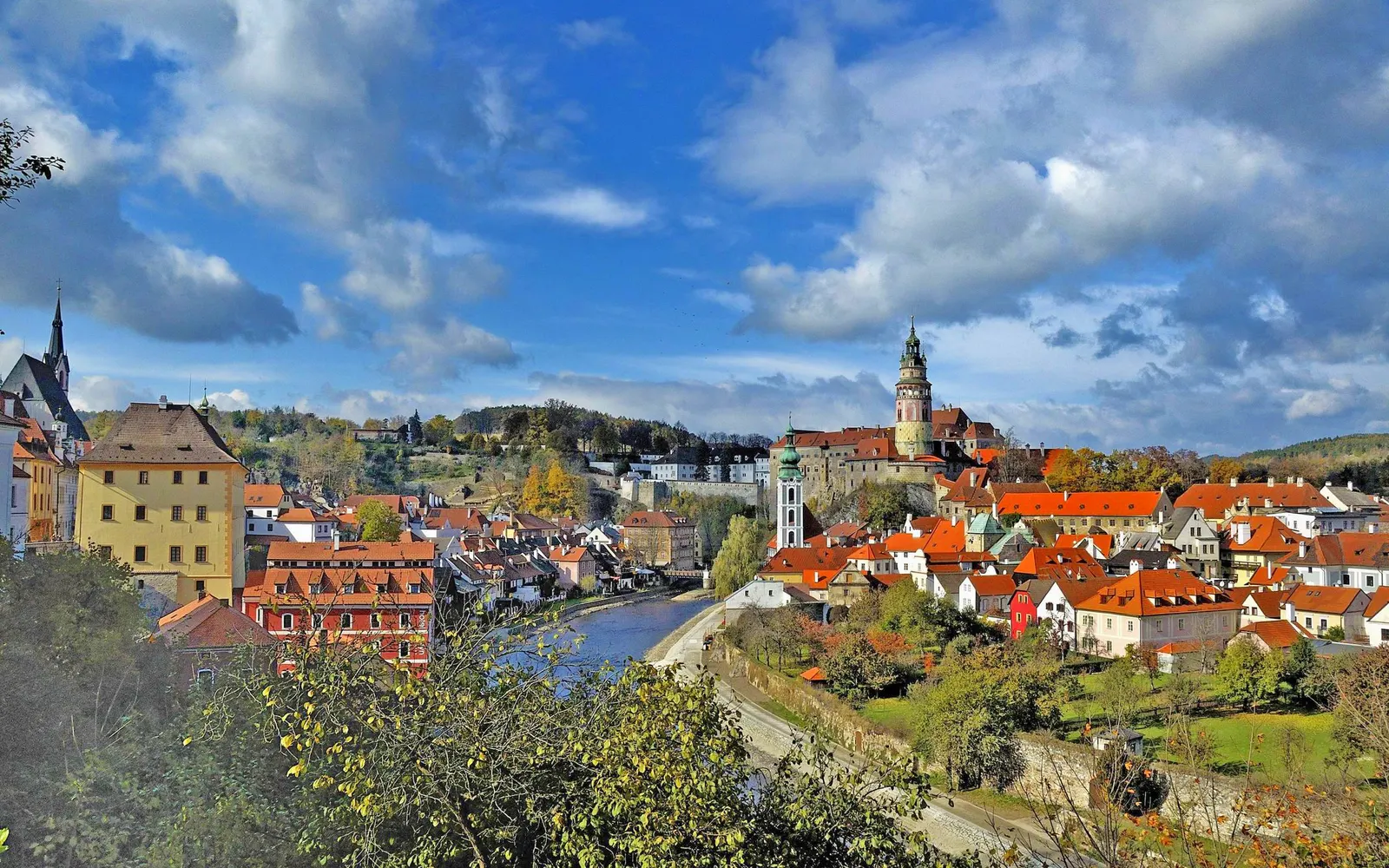
Český Krumlov Castle's painted Renaissance tower rising above the red rooftops of the UNESCO-listed old town, on a horseshoe bend of the Vltava river in South Bohemia.

South Bohemia, Czech Republic

Where a painted tower guards a town caught in the Vltava's bend

The Renaissance and Baroque residence of the Rožmberk, Eggenberg and Schwarzenberg lords — second in size only to Prague Castle — guided-tour entry in your own language, including the reservation-only Baroque Theatre, booked before it sells out.

  1. 2ndLargest castle complex in the Czech Republic, after Prague Castle itself
  2. 13th c.Founded by the Lords of Krumlov on a rock above a bend in the Vltava river
  3. 20Maximum group size on the reservation-only Baroque Theatre tour — one of Europe's few intact 18th-century stage theatres
  4. 1992UNESCO inscribed the historic town and castle complex as a World Heritage Site

Guided tours

Three crossings of the Cloak Bridge

The interiors are seen only on guided tours, and each route is a different tour with its own departure times. You pick the date and the departure at checkout; the whole party goes in together.

Level I Most chosen

Route I — Renaissance & Baroque Apartments

Adult aged 25–64 · guided tour in your language through the Renaissance and Baroque state apartments

€28adult

Reserve tour
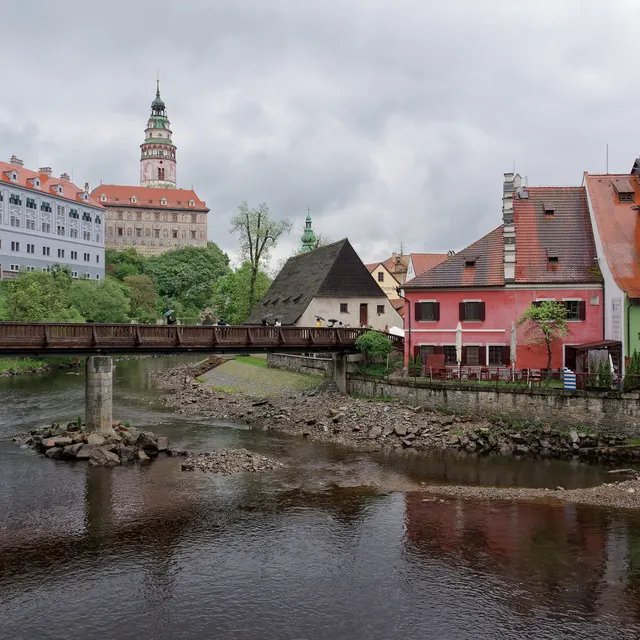
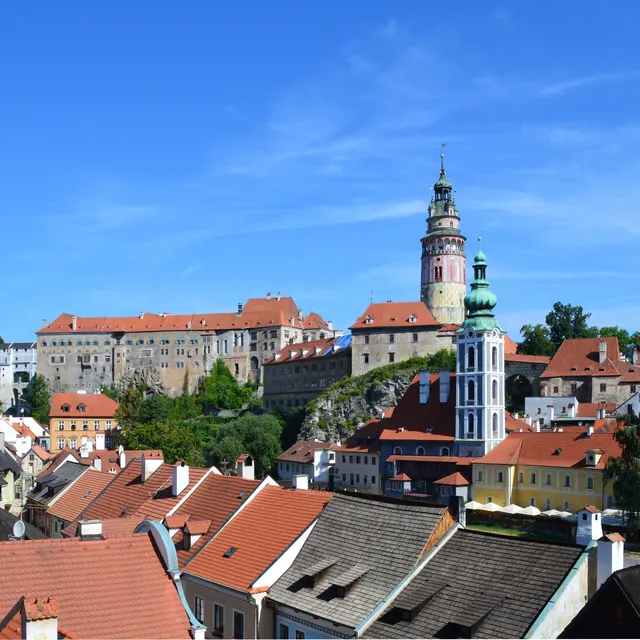
Panorama of Český Krumlov with the castle tower and the old town roofs
  • A confirmed place on a guided tour of the Renaissance and Baroque apartments, in your language
  • The Castle Chapel of St George and the Masquerade Hall, with its painted illusion of a costumed ball
  • The castle's four centuries as the seat of the Rožmberk, Eggenberg and Schwarzenberg families, told by your guide
  • Plain-English joining notes sent before your visit
Level II

Route II — 19th-Century Apartments & Cloak Bridge

Adult aged 25–64 · guided tour in your language through the Schwarzenberg-era apartments and portrait gallery

€26adult

Reserve tour
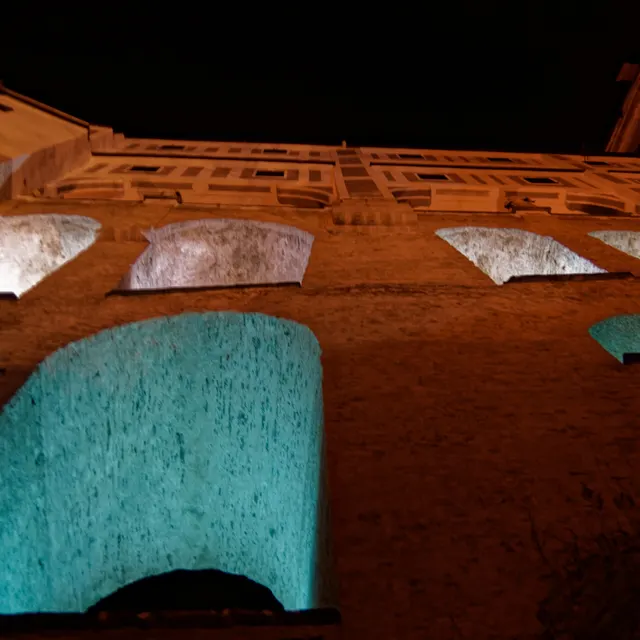
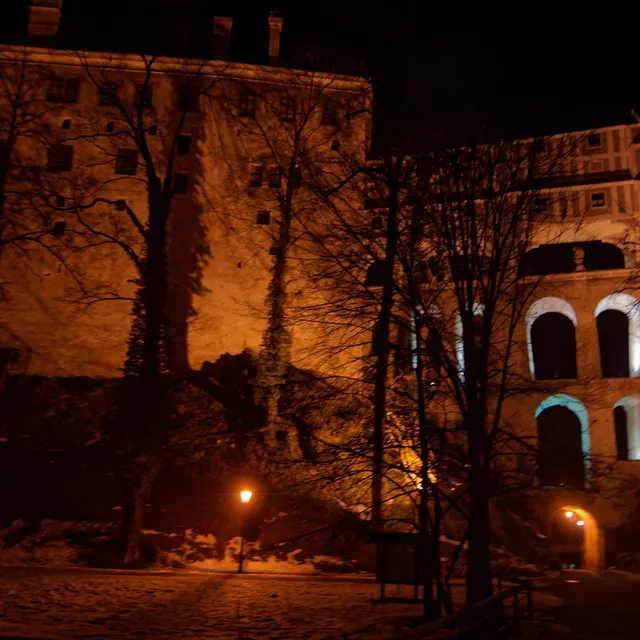
The Cloak Bridge of Český Krumlov Castle lit at night
  • A confirmed place on a guided tour of the 19th-century apartments, in your language
  • The Schwarzenberg family portrait gallery and richly furnished period rooms
  • The covered corridors of the Cloak Bridge, the multi-tiered arched bridge linking castle to garden
  • Plain-English joining notes sent before your visit
Level III

Baroque Theatre

Adult aged 25–64 · the reservation-only tour of the castle's 18th-century Baroque Theatre, capped at 20 per group

Reservation-only · 20 per group · season only · sells out days to weeks ahead

€44adult

Reserve Theatre tour
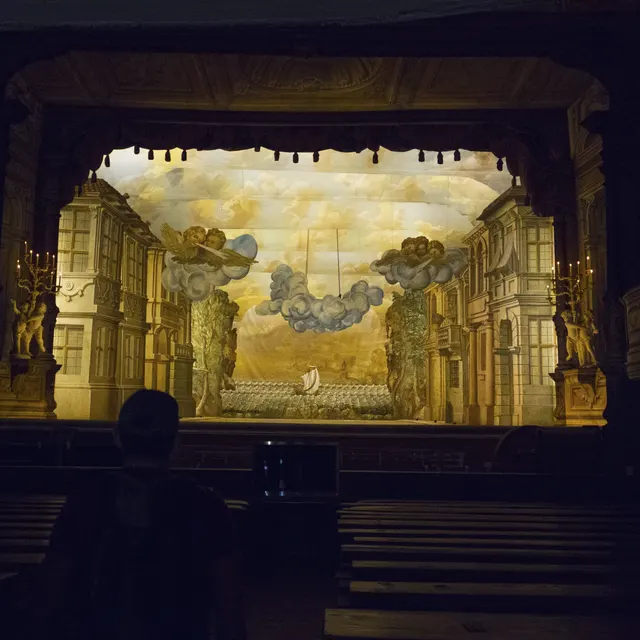
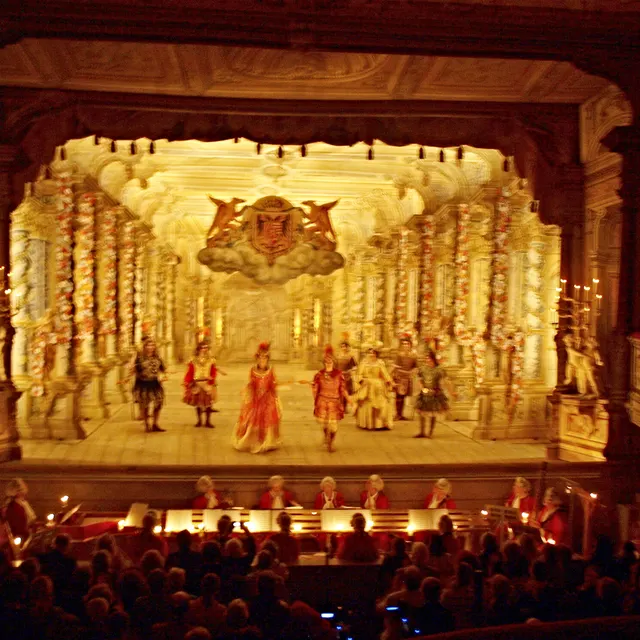
The stage of the Baroque Theatre at Český Krumlov Castle with its painted scenery
  • A confirmed place on the reservation-only guided Baroque Theatre tour (max 20 per group), in your language
  • The original 18th-century stage machinery, painted scenery and costumes — among the very few complete sets left in the world
  • The story of Josef Adam of Schwarzenberg's court theatre, told by your guide
  • We show only departures the operator confirms are open, and send plain-English joining notes

Youth 18–24, senior 65+ and child 6–17 reductions are chosen at checkout for every route. Children under 6 go free with no ticket.

Guided departures leave at set times. Your ticket shows the confirmed departure, and plain-English joining notes follow by email.

The courtyards, the tower climb and the gardens are separate from these tours and are not sold here.

The Rožmberk rose
Checkout in your languageTotal price shown in your currency, no Czech-only booking form
Route clarity before you payWhich apartments each tour actually shows, and how the theatre works
Ticket ready for travelConfirmed departure time and joining notes on your phone before you leave
Human help at any hourA person in your language, before the trip and on the day of the tour

The Baroque Theatre

Backstage, the machinery still works

The capTwenty people per group, no exceptions — the original stage and its machinery cannot take more.

Český Krumlov's finest interiors are seen only on guided tours with capped, timed departures. The Baroque Theatre — one of only a handful of 18th-century theatres anywhere still fitted with its original stage machinery, scenery and costumes — takes just 20 people per group, runs only in season, and sells out days to weeks ahead in high season.

The seasonThe theatre tour runs only in season. Outside it, the routes through the apartments still run.

The castle is open through most of the year, with guided-tour departures at set times during the day; the reservation-only Baroque Theatre tour runs only in season. Exact opening and last-departure times vary by season, and your ticket shows your confirmed departure time.

The sell-outsIn high season the theatre departures go days to weeks ahead. We show only departures the operator confirms are open.

That theatre tour is where a booking service earns its place. It is reservation-only, capped at twenty people per group and offered only in season, so international visitors who simply turn up are routinely turned away. We watch the operator's live availability, secure a guided departure in your language on the date you want, explain which route covers which rooms, and make sure a sold-out day doesn't cost you one of Bohemia's rarest theatrical survivals.

What the service actually does

  • A confirmed guided-tour slotThe date and time you want, on a guided tour in your language — held the moment you book
  • The right route, decodedWhich route covers which apartments, and how the reservation-only Baroque Theatre works — explained before you pay
  • No sold-out surprisesWe watch the operator's live availability so a full Theatre tour doesn't end your plans

The castle

A rock in the bend of the Vltava

Český Krumlov Castle rises on a rocky spur above a horseshoe bend of the Vltava river in South Bohemia, the second-largest castle complex in the Czech Republic after Prague Castle itself. Founded in the thirteenth century by the Lords of Krumlov, it passed for nearly three hundred years to the Rožmberk (Rosenberg) family, then briefly to the Habsburgs, before the Eggenberg and later Schwarzenberg families made it their Renaissance and Baroque seat. The town below is inscribed by UNESCO as a World Heritage Site, and the castle's painted Renaissance tower is one of the most photographed sights in Bohemia.

The painted Renaissance tower of Český Krumlov Castle above the red roofs of the old town
The painted tower

The castle's interiors are seen only on guided tours, and three routes reveal very different parts of the story. Route I leads through the Renaissance and Baroque state apartments, including the Castle Chapel of St George and the Masquerade Hall, its walls covered in painted figures in carnival dress watching over every visitor. Route II covers the more intimate nineteenth-century apartments furnished by the Schwarzenberg family, its portrait gallery, and the covered timber corridors of the Cloak Bridge — the tiered arched bridge that strides across the ravine to the castle garden. A third, separate tour reaches the castle's Baroque Theatre, rebuilt into its present form for Prince Josef Adam of Schwarzenberg in the 1760s, one of only a handful of theatres anywhere still fitted with its original stage sets, machinery and costumes.

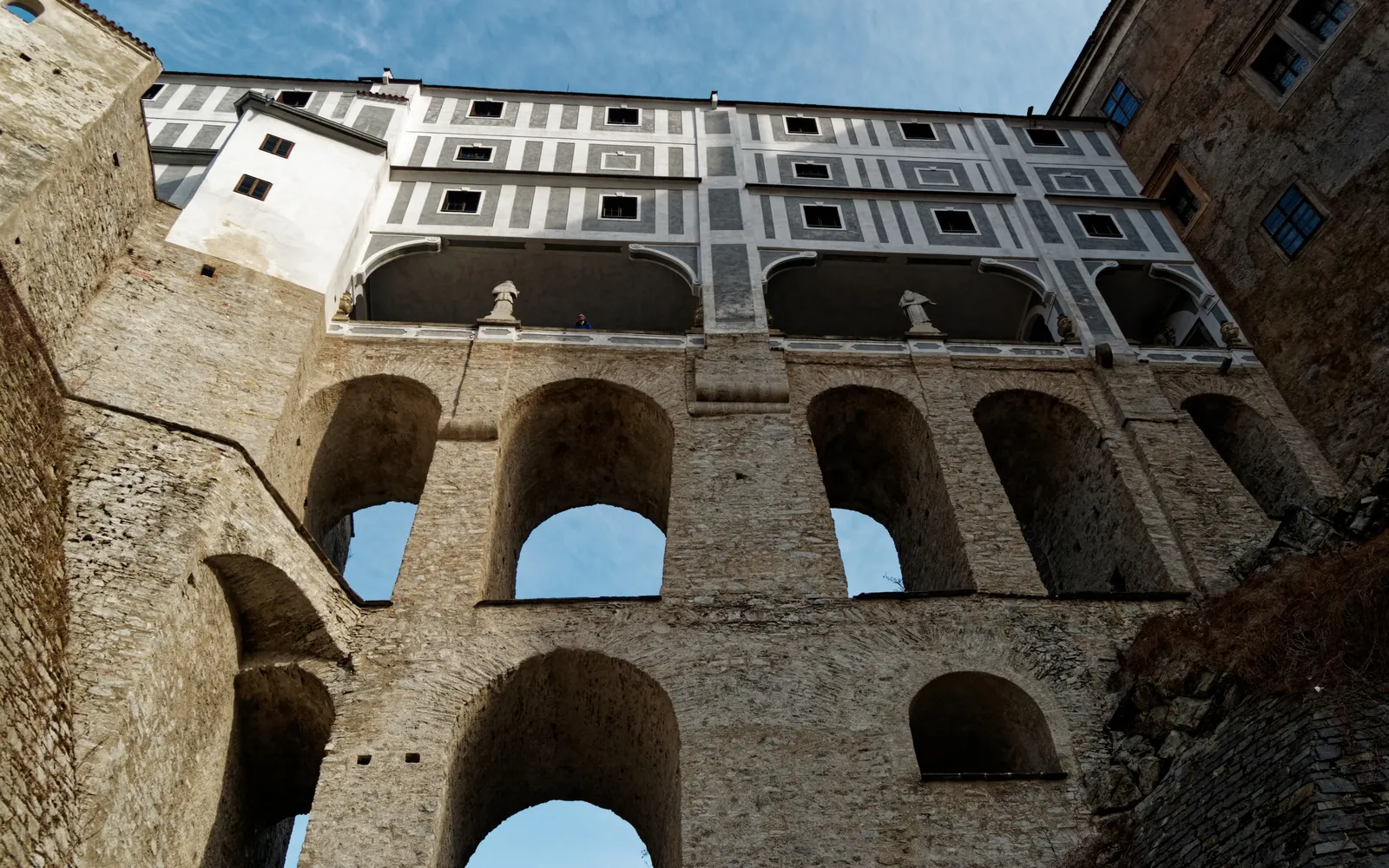
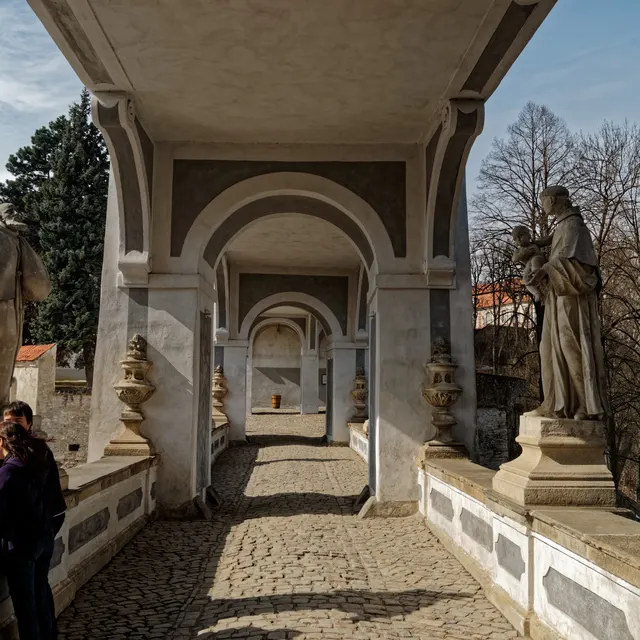
The tiered arches of the Cloak Bridge at Český Krumlov Castle seen from below
The Cloak Bridge from below

That theatre tour is where a booking service earns its place. It is reservation-only, capped at twenty people per group and offered only in season, so international visitors who simply turn up are routinely turned away. We watch the operator's live availability, secure a guided departure in your language on the date you want, explain which route covers which rooms, and make sure a sold-out day doesn't cost you one of Bohemia's rarest theatrical survivals.

Your 5-minute Český Krumlov Castle pre-visit briefing

A short, calm history — how a bend in a river gave a Bohemian castle its name, why the Rožmberk lords built a theatre nobody was meant to enter twice, and what to look for on the climb to the painted tower. Listen on the walk up from the old town.

Recorded for Český Krumlov Castle Tickets concierge. Free to download.

Visitor guide

Five courtyards up the rock

The castle climbs its rock through five courtyards. The guide climbs with it: seventeen answers, grouped by the courtyard where the question comes up. Tap a door.

Everything an international visitor needs to plan a visit to Český Krumlov Castle in South Bohemia — what the castle is, the difference between the three guided routes, why the Baroque Theatre tour sells out, how to reach Český Krumlov, and how the tickets work.

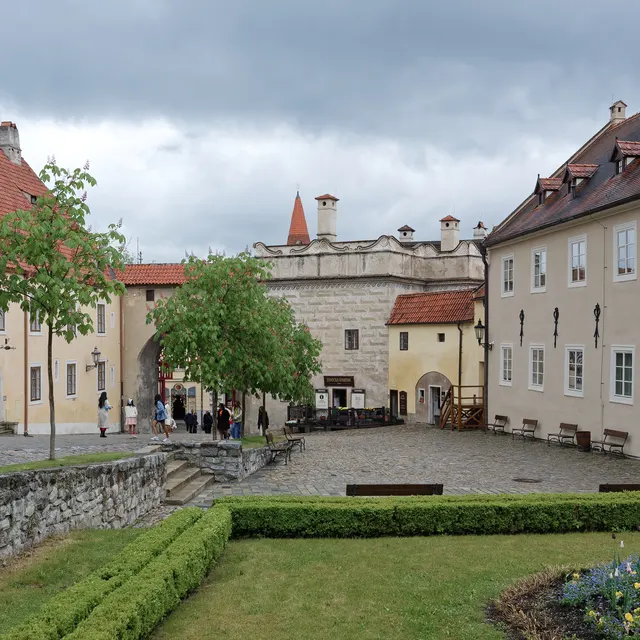
  1. The first courtyard of Český Krumlov Castle with its sgraffito facades

    Courtyard IAt the gate

    The second castle of BohemiaČeský Krumlov Castle stands on a rocky spur wrapped by a horseshoe bend of the Vltava river, in the heart of South Bohemia.

    Český Krumlov Castle stands on a rocky spur wrapped by a horseshoe bend of the Vltava river, in the heart of South Bohemia. Founded in the thirteenth century by the Lords of Krumlov, it passed in 1302 to the powerful Rožmberk (Rosenberg) family, who held it for nearly three centuries and transformed a medieval stronghold into a Renaissance residence. After a brief spell in Habsburg hands the castle went to the Eggenberg family in 1622, and from 1719 to the Schwarzenbergs, whose descendants shaped much of what visitors see today. It is now the second-largest castle complex in the Czech Republic, smaller only than Prague Castle.

    The complex is really a small town in itself: forty-odd buildings and palaces strung along the ridge, linked by the multi-tiered Cloak Bridge and crowned by a slender, sgraffito-painted Renaissance tower visible for miles. Below it, the old town of Český Krumlov curls around the river in the same horseshoe shape, and together castle and town form a UNESCO World Heritage Site. As an independent booking-assistance service we are not the castle or its operator, but we help international visitors reach it with confidence, securing a guided tour in your own language on the date you want and explaining what each route reveals before you climb the hill.

    Three routes — and the one that sells outThe castle's interiors can only be seen on a guided tour, and the most useful thing to understand before you book is that three separate routes cover three quite different parts of the story.

    The castle's interiors can only be seen on a guided tour, and the most useful thing to understand before you book is that three separate routes cover three quite different parts of the story. Route I leads through the Renaissance and Baroque state apartments — the Castle Chapel of St George and the Masquerade Hall, whose walls are covered in painted figures in carnival costume that seem to watch you from every angle. It is the classic introduction to the castle and runs through most of the year.

    Route II covers the more domestic nineteenth-century apartments furnished during the Schwarzenberg era, the family's portrait gallery, and the covered timber corridors of the Cloak Bridge as it strides across the ravine towards the castle garden. The third and separate tour is the one people travel for: the castle's Baroque Theatre, rebuilt into its present form for Prince Josef Adam of Schwarzenberg in the 1760s, one of only a handful of theatres left in the world with its original stage machinery, painted scenery and costumes intact. To protect these fragile survivals the operator limits the tour to twenty visitors per group and runs it only in season, which is exactly why it so often shows as full. We are not the operator or an official partner; what we offer is a concierge service in your own language that makes sure you book the right route, and don't miss the theatre for the sake of a reservation you didn't know you needed.

    Getting to Český Krumlov from PragueČeský Krumlov sits about 170 km south of Prague in South Bohemia, close to the Austrian border, and is reachable without a car.

    Český Krumlov sits about 170 km south of Prague in South Bohemia, close to the Austrian border, and is reachable without a car. The most comfortable route is a direct coach — operators such as RegioJet and FlixBus run frequent services taking around two and a half to three hours. There is no direct train from Prague; rail travellers must change at České Budějovice, adding time to the journey. From the Český Krumlov bus station it is a walk of roughly fifteen to twenty minutes into the old town and up the hill to the castle gate, mostly on cobbled streets.

    If you are arriving from Václav Havel Airport Prague, reach the city centre first by bus or taxi, then continue on a direct coach south. Travellers already in Austria can also reach Český Krumlov from Linz or Vienna by coach in roughly one and a half to two and a half hours, a popular route for anyone combining the Czech Republic with an Austrian itinerary. Because the tours are guided departures leaving at fixed times, build in a comfortable margin for the coach journey and the walk up from the bus station rather than arriving flustered. Wear comfortable shoes for the cobbles and bring a light layer, as the castle interiors stay cool year-round. As a booking-assistance service in your own language, we send clear directions with your confirmation so the journey is one less thing to work out on the day.

    Understanding the ticketsČeský Krumlov's tickets are organised by route and by visitor type, and choosing the right combination is simpler than the operator's own listings can make it look.

    Český Krumlov's tickets are organised by route and by visitor type, and choosing the right combination is simpler than the operator's own listings can make it look. Each of the three tours is sold with a standard adult ticket, a reduced ticket for eligible visitors such as seniors aged sixty-five and over and young people aged eighteen to twenty-four, for which you should carry photo identification, and a child ticket for ages six to seventeen. Children under six enter free and need no ticket. Pick the route you want and the tier that matches each member of your party at checkout, and we confirm the details before we buy so there are no awkward surprises at the entrance.

    The crucial choice is which route, or routes. Route I covers the Renaissance and Baroque apartments and runs year-round; Route II covers the nineteenth-century apartments and the Cloak Bridge; the Baroque Theatre is a separate, reservation-only ticket, capped at twenty people and available only in season. If the theatre is your reason for coming, book it earliest and separately from the other routes. We publish prices in your own currency with our service fee included, and we do not list the operator's official pricing or claim to be its ticket office. For most first-time visitors, Route I for the apartments, Route II for the Cloak Bridge and portrait gallery, or the Baroque Theatre for its rare survival — or a combination where the timings allow — is exactly the booking to make.

  2. The open corridor on the Cloak Bridge with its Baroque statues

    Courtyard IIThe routes

    The Baroque TheatreThe Baroque Theatre is the reason many visitors make the trip to Český Krumlov at all.

    The Baroque Theatre is the reason many visitors make the trip to Český Krumlov at all. Rebuilt into its present Baroque form for Prince Josef Adam of Schwarzenberg in the 1760s, on the site of an earlier seventeenth-century theatre, it is one of only a small number of theatres left anywhere in the world that survive with their original eighteenth-century stage sets, machinery and costumes essentially intact. Stepping onto the stage, you can still see the wooden drums and winches that once produced wind, thunder and rolling waves, the painted scenery flats that slide into place from the wings, and racks of costumes made for performances staged for the Schwarzenberg court centuries ago.

    Because the sets and machinery are original and fragile, access is tightly controlled. The tour admits only twenty people at a time, runs on a limited seasonal calendar, and books out well ahead in summer, which is precisely why casual travellers so often miss it. As a concierge service we watch the operator's live availability filtered to guided departures in your own language, hold your place the moment a slot is open, and can often catch a released or cancelled place when the tour first shows as full, so that a single fragile reservation doesn't stand between you and one of Europe's rarest working theatres.

    Visiting with childrenČeský Krumlov makes a memorable family outing.

    Český Krumlov makes a memorable family outing. The old town below the castle looks like a storybook set, and the castle itself — a painted tower, a bridge striding across a ravine, and a theatre with real working stage machinery — tends to capture children's imaginations in a way that a plain museum rarely does. Route I, through the Renaissance and Baroque apartments, suits families particularly well: it is the classic introduction to the castle, and the Masquerade Hall's painted crowd of costumed figures is a natural talking point for younger visitors. Children aged six to seventeen have their own reduced-price child ticket, and under-sixes enter free, so a family visit is straightforward to arrange.

    It is worth planning for the walking and the stairs. The old town and castle approach involve cobbled streets and gentle slopes, and there are staircases inside the castle interiors and along the tiered Cloak Bridge. Bring comfortable shoes and a light layer, as the interiors stay cool year-round. The castle courtyards and gardens are free to wander and give children room to run between tours. As a concierge service in your own language we are glad to talk through which route suits your family before you commit, so you book the visit that genuinely fits your group rather than discovering the mismatch at the gate.

    When to book your guided tourČeský Krumlov is busy in a predictable pattern, because its interiors are seen on timed, capped guided departures, each with a fixed start.

    Český Krumlov is busy in a predictable pattern, because its interiors are seen on timed, capped guided departures, each with a fixed start. Summer weekends and Czech public holidays are the tightest stretches, when the old town fills with day-trippers and the Baroque Theatre tour can sell out well in advance. Early departures soon after opening, and later afternoon tours, tend to keep spare places closer to the date, simply because fewer people default to them, and the interiors look the same whichever slot you choose.

    The season matters as much as the hour. Routes I and II run through most of the year, but the Baroque Theatre operates only in season, so a winter visit cannot include it at all — an essential point to know before you fix your dates. Spring and autumn offer a quieter old town with comfortable walking weather for the cobbled streets, while high summer is at once the busiest and the most reliable time for the full range of tours. Whatever the timing, if the theatre matters to your trip, treat it as an appointment to lock in first and let the rest of your South Bohemia itinerary flex around it. As a concierge service we watch live availability and can flag a place the moment one opens.

    Planning it into your tripČeský Krumlov rewards an overnight stay rather than a rushed day trip from Prague, not least because the coach journey each way already takes the better part of three hours.

    Český Krumlov rewards an overnight stay rather than a rushed day trip from Prague, not least because the coach journey each way already takes the better part of three hours. A common rhythm is to arrive in the afternoon, explore the old town and castle courtyards as the crowds thin, take a guided tour the following morning while it is quiet, and use a second day for the town's museums, the river and the surrounding countryside. Because the castle's interiors run on timed, capped departures — and the Baroque Theatre is both reservation-only and seasonal — the sensible approach is to pin down your tour first, then build the rest of the stay around it.

    If your wider itinerary also takes in Prague or a stop in Austria via Linz or Vienna, lock down the hardest reservation first — which at Český Krumlov means the Baroque Theatre — and arrange the coach connections to fit. The bus timetable and the walk up from the station are the two variables to plan around, so confirm your tour before fixing travel times. Many visitors combine the castle with a relaxed evening in the old town's restaurants and riverside beer gardens, making an easy, scenic escape from Prague. As an independent booking-assistance service we handle that anchoring step for you, holding your tour in your own language and sending clear joining notes, so the castle slots cleanly into your trip rather than dictating it.

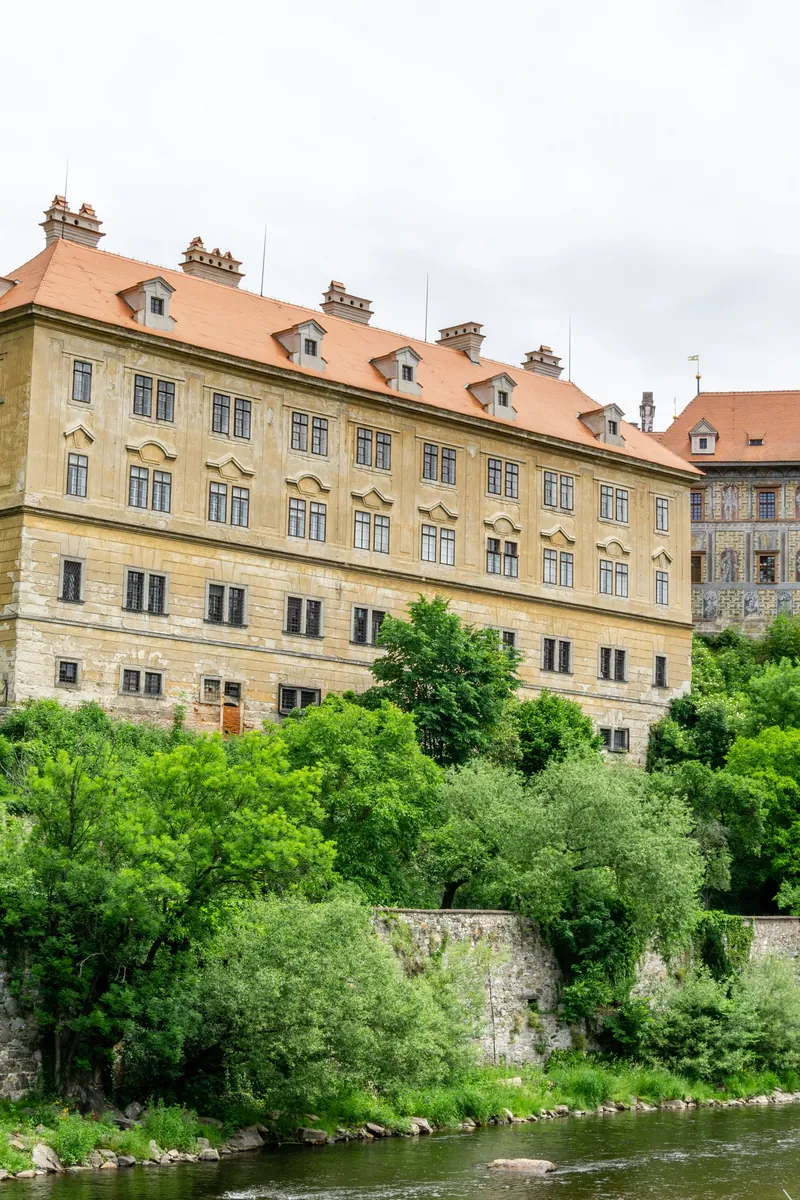
  3. The Vltava river below Český Krumlov Castle with the castle on its rock

    Courtyard IIIGetting there and around

    Who built Český Krumlov Castle?The castle was begun in the mid-thirteenth century by the Vítkovci, the Lords of Krumlov, on a rocky headland above the Vltava.

    The castle was begun in the mid-thirteenth century by the Vítkovci, the Lords of Krumlov, on a rocky headland above the Vltava. In 1302 it passed to the Rožmberk (Rosenberg) family, the most powerful noble house in South Bohemia, who held it for nearly three centuries and turned the medieval fortress into a graceful Renaissance residence. Their five-petalled rose still appears throughout the complex. The Rosenbergs were its greatest patrons, commissioning much of the painted decoration, the sgraffito tower and the layout visitors admire today, and it is largely their taste that gives Český Krumlov its Renaissance character.

    When the Rosenberg line ended, the estate passed briefly to the Habsburgs and then, in the seventeenth century, to the Eggenberg family, whose head was made Duke of Krumau. In the early eighteenth century it came to the Schwarzenbergs after the Eggenberg male line died out, and they held it until the twentieth century, furnishing the nineteenth-century apartments and rebuilding the celebrated Baroque Theatre. This layered patronage is why a single visit spans Renaissance halls, Baroque state rooms and comfortable nineteenth-century interiors. Knowing which family shaped which rooms helps you choose between the guided routes, and we are glad to explain the distinctions before you book.

    Can you climb the painted Castle Tower?Yes — the Castle Tower is one of the few parts of the complex you can visit without joining a guided tour, and it is among the most rewarding.

    Yes — the Castle Tower is one of the few parts of the complex you can visit without joining a guided tour, and it is among the most rewarding. The round tower dates from the thirteenth century but owes its famous appearance to a Renaissance remodelling: its surface is covered in sgraffito and painted decoration from around 1580, flat stonework made to look richly carved and three-dimensional. It rises above the Little Castle at the heart of the complex, and its slender, colourful form is the single image most associated with Český Krumlov and one of the most photographed sights in Bohemia.

    Climbing the tower is a separate ticket from the guided apartment routes, and it involves a narrow spiral staircase up to a viewing gallery near the top. From there the reward is a sweeping panorama over the red rooftops of the old town, the horseshoe bend of the Vltava directly below, and the wooded hills of South Bohemia beyond. The climb is not long, but the stairs are steep and enclosed, so it may not suit everyone. Because it is a self-guided climb rather than a timed departure, it makes an easy addition either side of a booked route.

    What is the Cloak Bridge?The Cloak Bridge (Plášťový most) is one of the castle's most dramatic structures: a tall, multi-tiered arched bridge that strides across a deep ravine, linking the upper castle to the gardens and the Baroque Theatre on the far side.

    The Cloak Bridge (Plášťový most) is one of the castle's most dramatic structures: a tall, multi-tiered arched bridge that strides across a deep ravine, linking the upper castle to the gardens and the Baroque Theatre on the far side. Built in its present form in the eighteenth century, it rises in several storeys of stone arches, with covered corridors running along the upper level so the noble household could pass between buildings without going outdoors. Seen from the ravine below it is an astonishing piece of engineering; seen from the town it frames the castle dramatically against the sky.

    Visitors can walk across the open level of the bridge freely as they move through the complex, enjoying the views down into the ravine and out over the town. The covered corridors along the upper tiers, however, form part of the Route II guided tour, which threads through them on the way between the nineteenth-century apartments and the garden side of the castle. If crossing those enclosed passages appeals to you, Route II is the tour that includes them, and we will make sure you book the route that reaches the part of the bridge you have in mind.

  4. A performance on the Baroque Theatre stage at Český Krumlov with original painted flats

    Courtyard IVInside on the tour

    Are the Castle Gardens and revolving theatre worth visiting?The Castle Gardens stretch along the ridge beyond the upper castle, a formal Baroque landscape of terraces, lawns, clipped hedges and an eighteenth-century cascade fountain.

    The Castle Gardens stretch along the ridge beyond the upper castle, a formal Baroque landscape of terraces, lawns, clipped hedges and an eighteenth-century cascade fountain. They are free to enter and open for a longer season than the interiors, making them an easy addition to any visit — a calm, green counterpoint to the busy old town below. In summer the gardens are among the most pleasant places in Český Krumlov to slow down, and the walk out to them from the upper castle rewards you with further views over the town and river.

    The gardens are also home to a famous revolving auditorium, an open-air theatre with a rotating bank of seating that has staged performances in the grounds since 1959. It is used for a seasonal programme of drama, opera and ballet in the evenings rather than as part of the daytime castle tours, and it is entirely separate from the historic Baroque Theatre inside the complex — a distinction that often confuses first-time visitors. If an evening performance under the open sky appeals to you, it runs to its own schedule; the daytime garden visit itself needs no ticket at all.

    Are there really bears in the castle moat?Yes — one of Český Krumlov's most unusual traditions is the keeping of bears in the dry moat crossed on the way into the castle, a custom that reaches back centuries.

    Yes — one of Český Krumlov's most unusual traditions is the keeping of bears in the dry moat crossed on the way into the castle, a custom that reaches back centuries. The story links the castle's Rosenberg lords to the powerful Italian Orsini family, whose name puns on the Italian word for bear, orso, and bears have been associated with the castle ever since. Pausing on the bridge over the moat to look down for the resident bears has become one of the complex's best-loved quirks, and a particular highlight for younger visitors making their way up to the courtyards.

    The moat lies on the free public route through the castle courtyards, so you can look for the bears without any ticket. Whether a bear is visible on any given day depends on the animals and the weather, and arrangements for their care can change over time, so we would not want to promise a sighting. If seeing the bears matters to your party — particularly with children — it is worth checking their current status close to your visit, and we are happy to confirm what we can when you book rather than let anyone set their heart on it unseen.

    Is the UNESCO old town worth exploring too?Český Krumlov is one of those rare places where the setting rivals the monument at its heart.

    Český Krumlov is one of those rare places where the setting rivals the monument at its heart. The historic centre, wrapped in the same horseshoe bend of the Vltava as the castle, was inscribed by UNESCO as a World Heritage Site in 1992 for its exceptionally well-preserved medieval and Renaissance townscape. Winding cobbled lanes, painted merchant houses, a Gothic church and small squares survive largely intact, and the whole town is best explored slowly and on foot, with the painted castle tower reappearing above the rooftops at almost every turn.

    Because the castle interiors are seen only on timed guided tours, the old town is the natural place to spend the hours around your booked departure. Riverside cafés, small museums, artisan workshops and beer gardens line the streets below the castle, and many visitors find the town alone justifies an overnight stay rather than a rushed day trip. We treat the castle tours as the fixed points in your plans, leaving you free to wander the UNESCO streets around them — which is exactly how most people come to enjoy Český Krumlov at its best.

  5. Český Krumlov Castle lit at night above the river

    Courtyard VBefore you go

    How accessible is Český Krumlov Castle?Český Krumlov is a genuinely historic site, and that brings some physical demands worth planning for.

    Český Krumlov is a genuinely historic site, and that brings some physical demands worth planning for. The old town and the approach to the castle are built on cobbled streets and slopes, the walk up from the bus station takes fifteen to twenty minutes, and the interiors are reached and toured on foot, with staircases between rooms and along the Cloak Bridge. The Castle Tower climb, in particular, is a steep, narrow spiral stair. For most visitors with reasonable mobility this is all manageable at an unhurried pace, especially with comfortable shoes for the cobbles.

    For anyone with limited mobility, a wheelchair user, or a family with a pushchair, some parts of the complex are more challenging than others, and arrangements can differ by route and by season. Rather than guess, we would always encourage you to tell us about any mobility needs in your party before booking, so we can confirm the current access provisions with the operator and help you choose the route that works best. The free garden and courtyard areas, on gentler ground, are often the easiest parts of the castle to enjoy.

    Can you take photographs at the castle?Outdoors, Český Krumlov is a photographer's delight, and you are free to take pictures throughout the castle courtyards, across the Cloak Bridge, in the gardens and along the streets of the old town.

    Outdoors, Český Krumlov is a photographer's delight, and you are free to take pictures throughout the castle courtyards, across the Cloak Bridge, in the gardens and along the streets of the old town. The classic view of the painted tower rising above the red rooftops and the river bend is one of the most photographed scenes in the whole country, and the changing light through the day makes early morning and late afternoon especially rewarding for exterior shots. Bring a wide lens if you have one; the tower and its setting are hard to frame in a single close view.

    Inside the historic interiors the rules are stricter. Photography is typically restricted or not permitted on the guided routes, and it is most tightly controlled in the Baroque Theatre, where the fragile original scenery, machinery and costumes are protected from flash and crowding. These conditions can change from season to season, so rather than rely on assumptions we confirm the current photography rules for your specific tour when we send your joining notes, so you know before you arrive exactly what you can and cannot capture on the day.

    What are the guided tours actually like?Every visit to the castle interiors is a guided group tour that leaves at a fixed time, rather than a wander-at-your-own-pace museum.

    Every visit to the castle interiors is a guided group tour that leaves at a fixed time, rather than a wander-at-your-own-pace museum. A guide leads your group from room to room, telling the story of the noble families and drawing attention to the details that make each space remarkable — the painted crowd of the Masquerade Hall, the gilded state rooms, the intimate nineteenth-century apartments. Each route lasts roughly an hour, and because groups are capped and depart on a timetable, the rooms rarely feel overwhelmingly crowded while your own tour is passing through them.

    Tours run in Czech by default, with departures in English, German and other languages offered on a set schedule rather than on demand, so the language you need and the time you want have to line up. This is one of the practical details that trips up international visitors most often, and it is a large part of what our service exists to solve. We secure a departure in your own language on the date you want, confirm the meeting point, and send plain-English joining notes, so all you have to do on the day is arrive and enjoy the tour.

Practical

The tower stair

  1. Step 1 Opening hours

    The castle is open through most of the year, with guided-tour departures at set times during the day; the reservation-only Baroque Theatre tour runs only in season. Exact opening and last-departure times vary by season, and your ticket shows your confirmed departure time.

  2. Step 2 Address

    Zámek 59, 381 01 Český Krumlov — the castle stands on a rocky spur above the old town in South Bohemia, about 170 km south of Prague.

  3. Step 3 Getting there

    The most comfortable route from Prague is a direct coach (services such as RegioJet or FlixBus), about two and a half to three hours; there is no direct train, so rail travellers change at České Budějovice. From the Český Krumlov bus station it is a walk of roughly 15–20 minutes into the old town and up to the castle gate.

  4. Step 4 Getting there from the airport

    From Václav Havel Airport Prague, reach the city centre by bus or taxi, then take a direct coach south to Český Krumlov (about three hours). Visitors arriving via Linz or Vienna in Austria can also reach Český Krumlov by coach in roughly one and a half to two and a half hours. Allow a comfortable margin, as the guided tours leave at fixed times.

  5. Step 5 Time needed

    Allow about an hour for each guided tour. With the painted Renaissance tower, the Cloak Bridge and the Baroque garden, a comfortable half-day covers the highlights, or a full day if you take more than one tour and explore the old town below.

  6. Step 6 Accessibility

    The old town and castle approach involve cobbled streets and slopes, and the Cloak Bridge is crossed on foot with some steps; the tours involve stairs within the castle interiors. If anyone in your party has mobility needs, tell us before booking and we'll confirm the current arrangements and alternatives.

  7. Step 7 Photography

    Photography rules differ by tour and are restricted inside the historic interiors, particularly the Baroque Theatre; we'll confirm the current conditions for your visit.

  8. Step 8 Food

    The old town below the castle is full of restaurants, cafés and riverside beer gardens; there is no full restaurant inside the castle itself.

Questions

The stagebook

Quick answers

What is Český Krumlov Castle?

Český Krumlov Castle is the second-largest castle complex in the Czech Republic, after Prague Castle, rising on a rocky spur above a bend of the Vltava river in South Bohemia. Founded in the thirteenth century by the Lords of Krumlov, it was later the Renaissance and Baroque seat of the Rožmberk, Eggenberg and Schwarzenberg families. Its best-known features are the painted Renaissance tower, the multi-tiered Cloak Bridge, and one of Europe's few surviving fully-equipped Baroque theatres. The historic castle and town together form a UNESCO World Heritage Site.

What is the difference between Route I, Route II and the Baroque Theatre tour?

Route I leads through the Renaissance and Baroque state apartments, including the Castle Chapel of St George and the Masquerade Hall, and runs year-round. Route II covers the nineteenth-century apartments furnished by the Schwarzenberg family, the family portrait gallery, and the Cloak Bridge corridors. The Baroque Theatre is a separate, reservation-only tour of the castle's original 18th-century stage, capped at 20 people per group and offered only in season. If seeing the theatre matters to you, book it separately and early, since it is the one that sells out.

Do I need to book in advance?

For the Baroque Theatre, strongly — it takes only 20 visitors per group, runs a limited season, and slots sell out days to weeks ahead in high season. Routes I and II are easier to join but departures are still timed and capped. Booking in advance is the difference between a confirmed guided tour and being turned away at the gate.

Is the visit a guided tour, and is it in my language?

Yes — the castle's interiors can only be seen on a guided tour, offered in several languages including Czech, English and German. We secure a tour in your language on your chosen date and send you plain-English joining notes.

Why is the Baroque Theatre so hard to get into?

The theatre's stage machinery, painted scenery and costumes are original eighteenth-century survivals, among the very few complete sets left anywhere in the world, so access is deliberately limited to protect them. Tours are capped at 20 people per group and run only in season, with a set number of departures each day. Demand from international visitors far outstrips those places, so tours fill fast. We watch the operator's live availability and can often secure a place — including released or cancelled slots — when one opens.

How long does it take, and how far is it from Prague?

Each guided tour lasts about an hour. Český Krumlov is roughly 170 km south of Prague — about two and a half to three hours by direct coach. Allow a comfortable half-day for one tour, or a full day if you take more than one and explore the old town.

How do I get to Český Krumlov from Prague?

The simplest way is a direct coach from Prague, such as RegioJet or FlixBus, taking around two and a half to three hours. There is no direct train, so rail travellers change at České Budějovice. From the Český Krumlov bus station it is a walk of about 15–20 minutes into the old town and up to the castle gate. We send clear directions with your confirmation.

Is it physically demanding?

The old town and castle approach involve cobbled streets and gentle slopes, and there are stairs inside the castle, including crossing the tiered Cloak Bridge. Most visitors with reasonable mobility manage comfortably. If anyone in your party has mobility needs, tell us before booking and we'll confirm the current arrangements.

Is Český Krumlov good to visit with children?

Very much — the town looks like a storybook set, and the castle's towers, bridges and painted halls tend to capture younger visitors. Route I suits families well. Children aged 6–17 have their own reduced ticket, and under-6s enter free. Bring comfortable shoes for the cobbled streets and a layer, as the interiors are cool.

How do the reduced tickets work?

The operator offers a reduced rate for eligible visitors such as seniors aged 65 and over and young people aged 18–24, and a separate child ticket for ages 6–17. Choose the tier that matches each member of your party at checkout; you may be asked to show photo ID at the castle. Children under 6 enter free and need no ticket.

Can I visit the castle grounds without a tour?

You can walk freely through the castle courtyards, across parts of the Cloak Bridge and around the Baroque garden, but the historic interiors — the state apartments on Routes I and II, and the Baroque Theatre — can only be seen on a guided tour with a dated ticket. That is what we help you book.

When is the best time to visit?

The interiors look the same whatever the season, so timing is mainly about booking pressure and weather. Summer, weekends and Czech public holidays are busiest, and the Baroque Theatre tour can sell out well ahead; spring and autumn are calmer with pleasant weather for walking the old town. Whatever the date, if the Theatre tour matters, book it first and shape the rest of your day around it. Remember it runs only in the warmer months.

What happens after I book?

Once you confirm and pay, we purchase the official dated guided-tour ticket from the operator's authorised channel on your behalf and send it to you by email, along with plain-English joining notes: which coach to take, how long the walk is, and where to meet your tour. You show the ticket at the castle.

Are you the castle, or an official partner?

Neither — we're an independent booking-assistance service for international visitors. We are not the castle, its operator or an official partner; we help you book and buy the official ticket in your own language, with our service fee included in the price. If you'd rather buy directly, the operator's official portal is vstupenky.npu.cz.

What is your refund policy?

Guided-tour tickets are dated and time-specific, and all sales are final once booked. If the operator cancels your tour — for operational or other reasons on their side — we refund you in full. We recommend travel insurance to cover changes to your own plans.

Can you book more than one tour on the same day?

Often yes, if the timings allow — Route I, Route II and the Baroque Theatre leave at set times, so we fit them together around the same visit where the schedule permits. Tell us you'd like more than one and we'll find a workable combination of departures, subject to the Theatre tour's live availability and its seasonal calendar.

Deeper planning

How do I get to Český Krumlov Castle from Prague?

Český Krumlov sits about 170 km south of Prague and is best reached by direct coach — operators such as RegioJet and FlixBus run services taking around two and a half to three hours. There is no direct train, so rail travellers must change at České Budějovice. From the Český Krumlov bus station it is a walk of roughly fifteen to twenty minutes into the old town and up to the castle gate, mostly on cobbled streets. Travellers already in Austria can also reach Český Krumlov from Linz or Vienna by coach in about one and a half to two and a half hours. Because the tours leave at fixed times, allow a comfortable margin to reach the castle.

What is there to see at Český Krumlov Castle?

The castle's interiors are seen on three separate guided routes. Route I covers the Renaissance and Baroque state apartments, including the Castle Chapel of St George and the Masquerade Hall, its walls painted with a crowd of costumed carnival figures. Route II covers the nineteenth-century apartments furnished by the Schwarzenberg family, their portrait gallery, and the covered corridors of the Cloak Bridge as it strides across the ravine to the castle garden. A separate tour reaches the Baroque Theatre, rebuilt into its present form for Prince Josef Adam of Schwarzenberg in the 1760s, one of only a handful of theatres in the world that still have their original stage machinery, painted scenery and costumes. Outside the guided routes, visitors can also walk freely through the castle courtyards, gardens and across parts of the Cloak Bridge.

Is Český Krumlov Castle worth visiting?

Český Krumlov is widely regarded as one of the essential heritage sites in the Czech Republic beyond Prague, and for most visitors it richly repays the journey. It is the country's second-largest castle complex, seat of three major noble families across seven centuries, set above one of the best-preserved medieval and Renaissance townscapes in Central Europe, protected as a UNESCO World Heritage Site. Its Baroque Theatre, with its original eighteenth-century stage sets still intact, is a genuine rarity found in very few places on earth. The painted Renaissance tower, the Cloak Bridge and the old town's winding streets make the visit as visually rewarding as it is historically significant, and it pairs naturally with a stay of a day or two in South Bohemia.

How long do you need at Český Krumlov Castle?

Plan on at least half a day for the castle itself, and ideally an overnight stay given the coach journey from Prague already takes two and a half to three hours each way. Each guided route lasts about an hour, so seeing one or two, together with a walk across the Cloak Bridge and through the gardens, fits comfortably into an afternoon. Many visitors add the Baroque Theatre as a separate tour and spend a further day exploring the old town, its museums and the riverside. Because the tours are guided and depart on a fixed schedule, arrive with a margin to spare so you join your booked tour without rushing.

When is the best time to visit Český Krumlov Castle?

Because entry runs on timed, capped guided departures, the best time to visit is mainly about booking pressure and season rather than the experience itself, which stays constant inside. Summer weekends and Czech public holidays are the busiest, when the old town fills with day-trippers and the Baroque Theatre tour can sell out well ahead; early-morning and later-afternoon departures tend to hold open places closer to the date. Crucially, the Baroque Theatre runs only in season, so a winter visit cannot include it — an important point when choosing your dates. Spring and autumn bring a quieter old town and pleasant walking weather, while high summer offers the fullest range of tours but the heaviest crowds. If the theatre matters, book that tour first and let the rest of your itinerary flex around it.

Can I visit Český Krumlov Castle without a guided tour?

You can walk freely through the castle's courtyards, gardens and across parts of the Cloak Bridge, enjoying the architecture and the views over the old town and river, but the historic interiors can only be seen on a guided tour with a dated ticket. That applies to the state apartments on Routes I and II and, most strictly of all, to the Baroque Theatre, which is reservation-only and capped at twenty people per group. There is no way to see the theatre's original stage machinery without booking a place on its dedicated tour. Booking the right route in advance is exactly what our service helps international visitors do.

Why is the Baroque Theatre tour so hard to book?

The Baroque Theatre preserves genuine eighteenth-century stage machinery, painted scenery and costumes, among the very few complete sets of their kind left anywhere in the world, so the operator protects them by strictly limiting access. The tour admits just twenty visitors per group, runs a limited number of times each day and operates only in season. Demand from international visitors far exceeds those places, so tours are consistently the first to sell out, often days to weeks ahead in high season. That mismatch is the single most common reason travellers arrive at Český Krumlov and miss the theatre. As a concierge service we watch the operator's live availability filtered to guided departures in your language, secure your place the moment a slot is open, and can often catch a released or cancelled place when the tour first shows full.

Who owned Český Krumlov Castle over the centuries?

The castle was founded in the thirteenth century by the Vítkovci, the Lords of Krumlov. In 1302 it passed to the Rožmberk (Rosenberg) family, who held it for nearly three centuries and made it a Renaissance residence. After a brief Habsburg interlude it went to the Eggenberg family in the seventeenth century, whose head became Duke of Krumau, and then in the early eighteenth century to the Schwarzenbergs, who held it until the twentieth century and rebuilt the Baroque Theatre. Three great noble houses across seven hundred years shaped the castle you visit today.

Can I climb the Castle Tower, and is it a separate ticket?

Yes. The painted Castle Tower can be climbed without joining a guided apartment tour — it is a separate, self-guided ticket. A narrow spiral staircase leads up to a viewing gallery with sweeping views over the red rooftops of the old town, the bend of the Vltava and the surrounding hills. The stairs are steep and enclosed, so the climb suits those comfortable on narrow steps. Because it is not a timed departure, it fits easily either side of a booked route.

What is the Cloak Bridge at Český Krumlov?

The Cloak Bridge (Plášťový most) is a tall, multi-tiered arched bridge that strides across a deep ravine, connecting the upper castle to the gardens and the Baroque Theatre on the far side. Built in its present form in the eighteenth century, it carries covered corridors along its upper level that once let the household move between buildings under cover. You can walk across the open level freely; the enclosed upper corridors are seen on the Route II guided tour.

Are there really bears in the castle moat?

By long tradition, yes — Český Krumlov keeps bears in the dry moat crossed on the way into the castle, a custom linked to the Rosenberg lords' association with the Italian Orsini family, whose name puns on the word for bear. The moat lies on the free public route through the courtyards, so no ticket is needed to look. Whether a bear is visible on any given day depends on the animals, and care arrangements can change over time, so we suggest checking their current status close to your visit rather than promising a sighting.

Are the Castle Gardens free to visit?

Yes. The Castle Gardens, a formal Baroque landscape of terraces, lawns and an eighteenth-century cascade fountain, are free to enter and open for a longer season than the interiors. They make a calm, green addition to a visit, with fine views back over the town, and need no ticket or guided tour. Only the historic interiors — the apartments on Routes I and II and the Baroque Theatre — require a dated guided-tour ticket.

What is the revolving auditorium in the gardens?

The revolving auditorium is an open-air theatre in the Castle Gardens with a rotating bank of seating that has staged performances in the grounds since 1959. It hosts a seasonal evening programme of drama, opera and ballet and is entirely separate from the historic Baroque Theatre inside the castle complex — a distinction that often confuses first-time visitors. The daytime garden visit needs no ticket, while the evening performances run to their own separate schedule.

Is the old town of Český Krumlov worth exploring?

Very much so. The historic centre was inscribed by UNESCO as a World Heritage Site in 1992 for its exceptionally well-preserved medieval and Renaissance townscape, wrapped in the same horseshoe bend of the Vltava as the castle. Cobbled lanes, painted merchant houses, small squares and riverside cafés reward slow wandering on foot, with the painted tower reappearing above the rooftops at every turn. Because the castle interiors run on timed tours, the old town is the natural place to spend the hours around your booked departure.

Is Český Krumlov Castle wheelchair accessible?

Český Krumlov is a historic hillside site with cobbled streets, slopes and staircases, so some parts are more challenging than others. The walk up from the bus station, the stairs between rooms and along the Cloak Bridge, and the steep tower climb all demand reasonable mobility. Access provisions can differ by route and season, so if anyone in your party has mobility needs, a wheelchair or a pushchair, tell us before booking and we will confirm the current arrangements with the operator. The gardens and courtyards, on gentler ground, are usually the easiest areas.

Can I take photographs inside the castle?

Outdoors you can photograph freely — the courtyards, the Cloak Bridge, the gardens and the old town, including the famous view of the painted tower above the river. Inside the historic interiors the rules are stricter: photography is typically restricted or not permitted on the guided routes, and most tightly controlled in the Baroque Theatre, where the fragile original scenery and machinery are protected. Because these conditions can change, we confirm the current photography rules for your specific tour in the joining notes we send before your visit.

What languages are the guided tours available in?

The castle interiors are seen only on guided group tours, which run in Czech by default, with departures in English, German and other languages offered on a set schedule rather than on demand. This means the language you need and the time you want have to line up, which is one of the details international visitors find hardest to arrange from abroad. We secure a departure in your own language on your chosen date, confirm the meeting point, and send plain-English joining notes.

How old is Český Krumlov Castle?

The castle was founded in the thirteenth century — a first fortress is recorded here in the 1250s — by the Vítkovci, the Lords of Krumlov, on a rocky headland above the Vltava. It grew over the following centuries under the Rosenberg, Eggenberg and Schwarzenberg families, from medieval stronghold through Renaissance residence to Baroque seat, so what you see today spans some seven hundred years of building. Its painted tower carries Renaissance decoration from around 1580, while the Baroque Theatre reached its present form in the 1760s.

Should I visit Český Krumlov as a day trip or stay overnight?

Both work, but many visitors prefer an overnight stay. The coach from Prague already takes two and a half to three hours each way, so a single day leaves the town busy and the schedule tight. Staying over lets you explore the old town as the day-trip crowds thin, take a guided tour in the quiet of the morning, and enjoy the riverside restaurants in the evening. If your time is limited, a day trip still covers the castle highlights — just book your guided tour first and plan the coaches around it.

Can I combine Český Krumlov with a visit from Austria?

Yes — Český Krumlov sits close to the Austrian border and is a popular stop for travellers combining the Czech Republic with Austria. Direct coaches run from Linz and Vienna in roughly one and a half to two and a half hours, making the castle an easy addition to an Austrian itinerary as well as a Prague one. Because the guided tours leave at fixed times, allow a comfortable margin for the coach and the walk up from the bus station, and we will send clear directions with your confirmation.

What is the Masquerade Hall?

The Masquerade Hall is one of the highlights of the Route I tour through the Renaissance and Baroque apartments. Its walls and ceiling are covered in a lifelike painted crowd of figures in carnival costume — musicians, dancers and masked revellers — created in the eighteenth century so that the room seems permanently filled with a costumed ball watching over every visitor. It is among the most photographed and best-loved interiors in the castle, and it is included on Route I rather than the other tours.
Sources: zamek-ceskykrumlov.eu, whc.unesco.org, en.wikipedia.org Last reviewed: